LAQUER ART AND DRAGON ICONOGRAPHY
The intersection of lacquer craftsmanship and sacred motif tradition in Thailand represents one of Southeast Asia's most refined decorative arts. Known natively as Lai Rod Nam (literally "ornaments washed with water"), high-grade Thai lacquer art combines organic material processing with intricate iconographic traditions rooted in Theravada Buddhism, Hindu cosmology, and regional mythology.
1. The Art of Thai Lacquer (Lai Rod Nam)
Thai gold leaf lacquerware relies on the natural resin derived from the Gluta usitata tree (formerly Melanorrhoea usitata), known locally as Nam Man Rak.
Technical Process
1. Preparation of the Substrate: Wooden panels, teak doors, or woven bamboo containers are meticulously sanded, filled, and coated with multiple base layers of black lacquer mixed with fine clay or wood ash. Each coat is dried under humid conditions and hand-polished smooth.
2. Resist Drawing (Hork): The master artisan paints the negative space of the design using a temporary, water-soluble yellow resist paint made from realgar (arsenic disulfide), gum arabic, and wild sour fruit juice.
3. Application of Lacquer & Gold Leaf: A thin, tacky layer of clear lacquer (Rak Som) is applied over the entire surface. Thin leaves of high-purity gold leaf (24K) are laid over the sticky surface, adhering to both the exposed wood and the resist paint.
4. The "Washing" (Rod Nam): Water is gently applied to the entire surface. The water-soluble yellow resist paint dissolves and washes away, taking the gold leaf above it with it, while the gold adhering to the lacquered areas remains intact. The result is a sharp, contrast-rich gold pattern set against a deep black background.
2. Dragon and Serpent Iconography in Thai Art
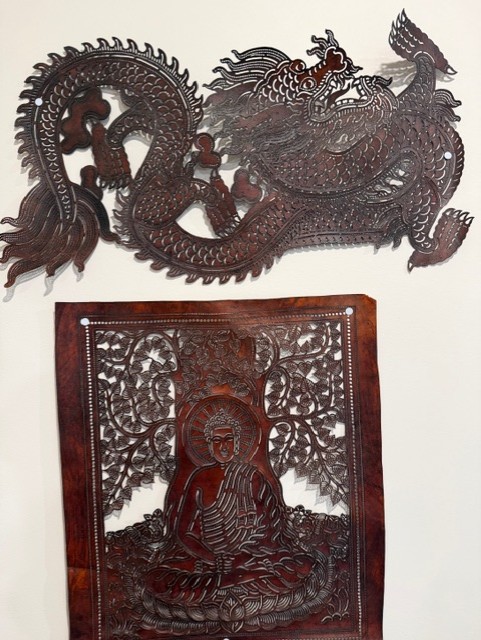
Unlike East Asian traditions (such as Chinese or Japanese art), where the imperial dragon (Long) dominates, Thai art centers its serpentine and draconian iconography primarily on the Nāga (Phaya Nak) and the Makara, alongside influences from Chinese trade art.
A. The Nāga (Phaya Nak)
The Nāga is a divine, semi-divine, or mythical serpent-god associated with water, fertility, and spiritual protection in Hindu-Buddhist cosmology.
Morphology: Depicted as a multi-headed giant cobra or a crested dragon-like serpent with scales, sharp fangs, and flame-like adornments.
Symbolic Role: Serves as a guardian of sacred spaces (frequently carved flanking temple staircases or lacquered onto monastic manuscript chests). In Buddhist tradition, the Nāga king Mucalinda sheltered the Buddha from a severe storm during his meditation.
Decorative Form (Kranok Integration): In Lai Rod Nam, the body of the Nāga often dissolves into or emerges from Kranok motifs-the signature flame- or vine-like fluid line patterns characteristic of classic Thai design.
B. The Makara
A composite aquatic creature combining features of an elephant/crocodile snout, aquatic body, and draconian jaws.
In Thai decorative panels, the Makara is frequently shown spewing forth Nāgas or ornate floral vines from its open mouth, symbolizing creation, abundance, and the flow of cosmic energy.
C. Sino-Thai Syncretism (Dragon Motif)
During the Ayutthaya (1351-1767) and early Rattanakosin (1782-present) eras, extensive maritime trade with China introduced traditional Chinese dragon motifs (Rong) into Thai decorative arts.
Thai artisans incorporated the Chinese four- or five-clawed dragon into royal furnishings, Mother-of-Pearl (Mook) inlay panels, and lacquer screens. Unlike traditional Thai Nāgas, these dragons are depicted amidst stylized clouds (Yunwen), chasing flaming pearls, or interlocked with classic Himmapan forest creatures.