


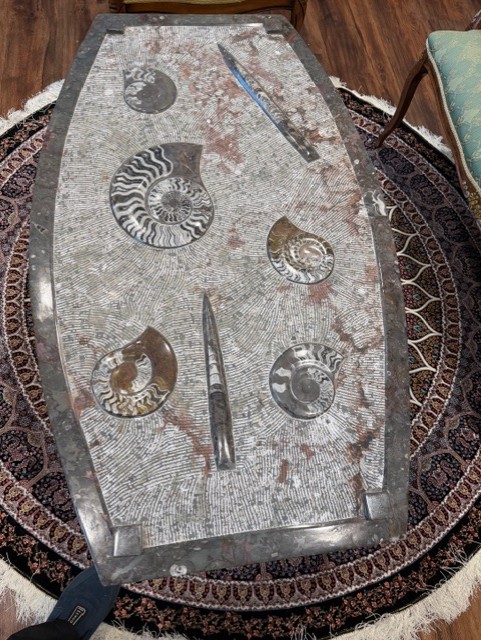
AMMONITES
Ammonites are an extinct group of marine mollusks belonging to the subclass Ammonoidea within the class Cephalopoda, making them close ancient relatives of modern squids, cuttlefish, and octopuses-rather than the externally similar Nautilus.
Geological Range: They first appeared in the fossil record during the Early Devonian period (c. 400 million years ago) and proliferated throughout the Mesozoic Era ("Age of Reptiles"). They were entirely wiped out during the Cretaceous-Paleogene (K-Pg) extinction event 66 million years ago alongside the non-avian dinosaurs.
Anatomy & Buoyancy: Ammonites lived inside the outermost, largest chamber (body chamber) of a multi-chambered shell. The inner chambers (phragmoccone) were connected by a vascular tube called a siphuncle. By regulating the ratio of gas and liquid in these chambers, the animal controlled its buoyancy and moved through the water column.
Index Fossils: Because ammonites evolved rapidly, diversified globally, and produced easily preserved aragonite shells, paleontologists use them as primary index fossils (biostratigraphy) to pinpoint the relative geological age of marine rock strata.
THE GOLDEN RATIO
The Golden Ratio-traditionally denoted by the Greek letter (phi)-is an irrational mathematical constant defined by a unique geometric proportion.
1. Mathematical Definition & Derivation
Two quantities and (where ) are in the Golden Ratio if the ratio of their sum to the larger quantity equals the ratio of the larger quantity to the smaller:
Solving this relation yields the quadratic equation . Applying the quadratic formula gives the exact value:
The Golden Ratio is intimately linked to the Fibonacci sequence (), where each term is the sum of the two preceding terms ().
A widespread misconception in popular science and art history claims that ammonites (and modern nautiluses) build their shells in the shape of the Golden Spiral.
While both ammonites and Golden Spirals belong to the family of logarithmic spirals (), empirical measurement reveals key distinctions:
Variable Expansion Rates: The Golden Spiral expands at a fixed rate of per quarter turn (or per full turn).
Ammonite Morphology: Paleontological analyses show that ammonite expansion rates () vary drastically across different species and families, typically ranging between and per half-turn. Almost no species matches the exact proportions of .
Functional Geometry: Ammonites utilize logarithmic spirals not to adhere to mathematical aesthetics, but because logarithmic growth allows for equiangular self-similarity-the shell expands continually at its aperture while maintaining identical structural, hydrodynamic, and buoyancy characteristics throughout the organism's lifetime.
ATLAS MOUNTAINS
The Atlas Mountains of North Africa-spanning Morocco, Algeria, and Tunisia-are globally recognized for their massive, highly visible Mesozoic limestone formations. The geological history, landscape features, and economic importance of limestone in this region involve several key aspects.
Fossil Preservation: The marine limestones of the Atlas region are rich in marine fossils, notably ammonites, belemnites, brachiopods, and bivalves. In the southern extensions (toward Erfoud and the Anti-Atlas), older Devonian and Cretaceous limestone beds yield world-famous orthoceras and ammonite fossil slabs.
Most limestone deposits date from 250 million years in the Mesozoic Ocean Basin and were subsequently thrust upward due to tectonic plate collision when Pangea evolved into Africa and Europe.