FURNITURE

LIMITED EDITION

BRONZE SCULPTURE

MAMMOTH CARVINGS

FLORENTINE MARBLE

ORIGINAL ART

GLASSWARE

EGYPT

MOROCCO

THAILAND

EUROPE
BOOK OF THE DEAD

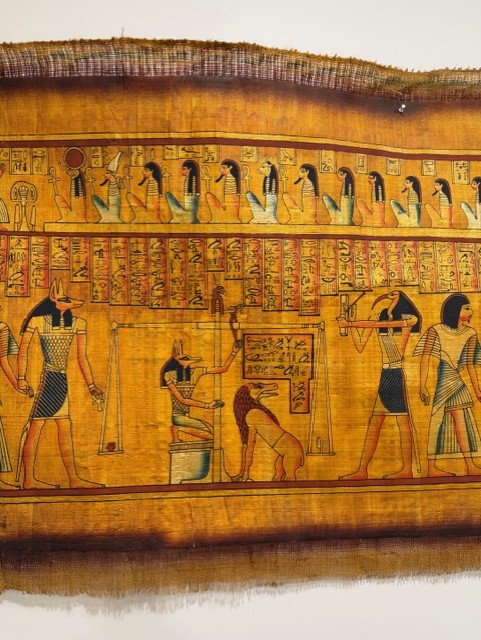
This papyrus depicts the famous "Weighing of the Heart" (Chapter 125 of the Book of the Dead), modeled after the 19th Dynasty papyrus of the royal scribe Hunefer (c. 1275 BCE, held in the British Museum).
This scene illustrates the crucial underworld trial determining whether a deceased soul gains eternal life in Aaru (the Field of Reeds) or suffers total destruction.
Key Figures & Elements (Left to Right)
1.        Top Register (The Divine Assembly):
*        Hunefer is shown kneeling in prayer, declaring his innocence ("Negative Confession") before a row of 14 seated deities who act as judges of the underworld.
2.        Left (Entrance to Judgment):
*        Anubis (jackal-headed god of embalming and the dead) holds Hunefer by the hand, leading him into the Hall of Two Truths.
3.        Center (The Scales of Ma'at):
*        Anubis appears a second time, kneeling to adjust the balance scale.
*        On the left pan sits Hunefer's heart (ib), representing his life actions and morality.
*        On the right pan is the Feather of Ma'at, symbol of truth, order, and cosmic justice.
*        Standing beneath the scale is Ammit ("Devourer of the Dead"), a hybrid monster with the head of a crocodile, forequarters of a lion, and hindquarters of a hippopotamus, waiting to devour any heart weighed down by sin.
4.        Right (Recording the Verdict):
*        Thoth (ibis-headed god of wisdom and writing) holds a reed pen and scribal palette, recording the result of the weighing.
*        Because Hunefer's heart balances perfectly with the feather, Thoth declares him Ma'a Kheru ("True of Voice"), permitting him to be presented to Osiris.

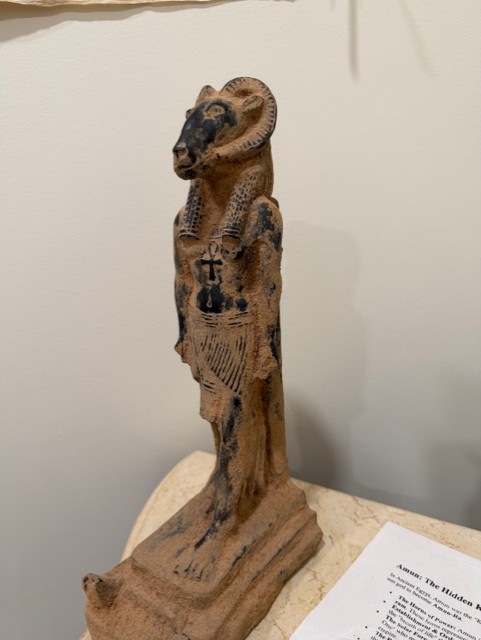
Amun: The Hidden King (The Ram)- LEADER
In Ancient Egypt, Amun was the "King of the Gods." By the New Kingdom, he merged with the sun god to become Amun-Ra.
This pieces is from a private collection of the family of Egyption workers who excavted tombs in th Valley of Kings (distinct from grave-robbers). Carbon dated to appx 2000BC.
*        The Horns of Power: Amun is depicted with the curved, downward-spiraling horns of a ram. These horns represent the life-giving "Ba" (soul) and the virility of a creator.
*        Establishment & Order: He was the god of the Pharaohs and the state. He represented the "breath of life" that sustained the entire cosmos.
*        The Solar Force: As a solar deity, Amun is a symbol of revelation. He is the "Hidden One" who makes himself known through the light of the sun and the success of the empire.
*        The Batterring Ram: Symbolically, the ram represents the ability to overcome obstacles through sheer force and determination. It is the "opener of the way."
*        Aries and the Zodiac: As the first sign of the Zodiac, Aries (the Ram) represents the start of spring, initiative, and the "I am" ego.
*        Sacrifice and Divinity: In the Abrahamic tradition, the ram replaced Isaac on the altar, shifting its symbolism toward a "divine substitute" and a high-status sacrifice.
*        Amun is the god of Who We Are as a civilization.

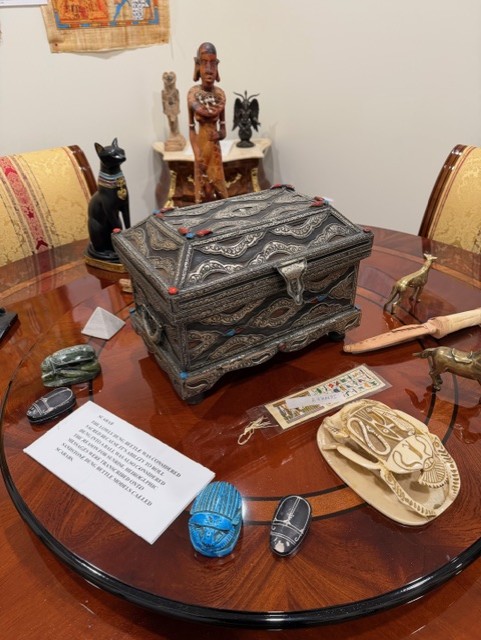
SCARABS
The history of the scarab-primarily modeled on the dung beetle (Scarabaeus sacer)-is one of ancient history's most enduring examples of how an observation in nature transformed into a central cosmic, political, and spiritual symbol.
Spanning over three millennia from ancient Egypt through the Mediterranean world, the scarab evolved from a humble insect into a potent emblem of creation, protection, and eternal life.
1. Biological Origins and Solar Symbolism
Ancient Egyptians observed dung beetles rolling large spheres of dung across the desert sands, burying them, and emerging from the ground as young beetles.
The Solar Analogy: The Egyptians drew a direct parallel between the beetle rolling its ball and the sun being moved across the sky.
Khepri and Spontaneous Generation: The beetle was linked to Khepri, the god of the rising sun and creation, whose name derives from the root kheper (meaning "to come into being," "to transform," or "to manifest"). Because young beetles appeared to emerge spontaneously from the earth, the Egyptians saw the scarab as a self-created entity symbolizing endless renewal and rebirth.
2. Chronological Evolution
Old Kingdom (c. 2686-2181 BCE): The earliest beetle artifacts were simple, unworked, or minimally detailed stone seals used without inscriptions.
Middle Kingdom (c. 2055-1650 BCE):
Scarabs became widely popularized. Artisans began carving detailed beetle anatomy on top while flattening the underside to serve as personal administrative seals, stamp impressions for clay, or amulets.
New Kingdom (c. 1550-1069 BCE):
Scarab production reached its artistic and ritual peak. Pharaohs used large scarabs as royal propaganda to commemorate events, and funerary scarabs became standard items in tomb equipment.
Third Intermediate & Late Periods (c. 1069-332 BCE):
Scarabs were exported across the Mediterranean, inspiring Phoenician, Etruscan, and Greek craftsmen who adapted the form for their own intaglio seals and jewelry.